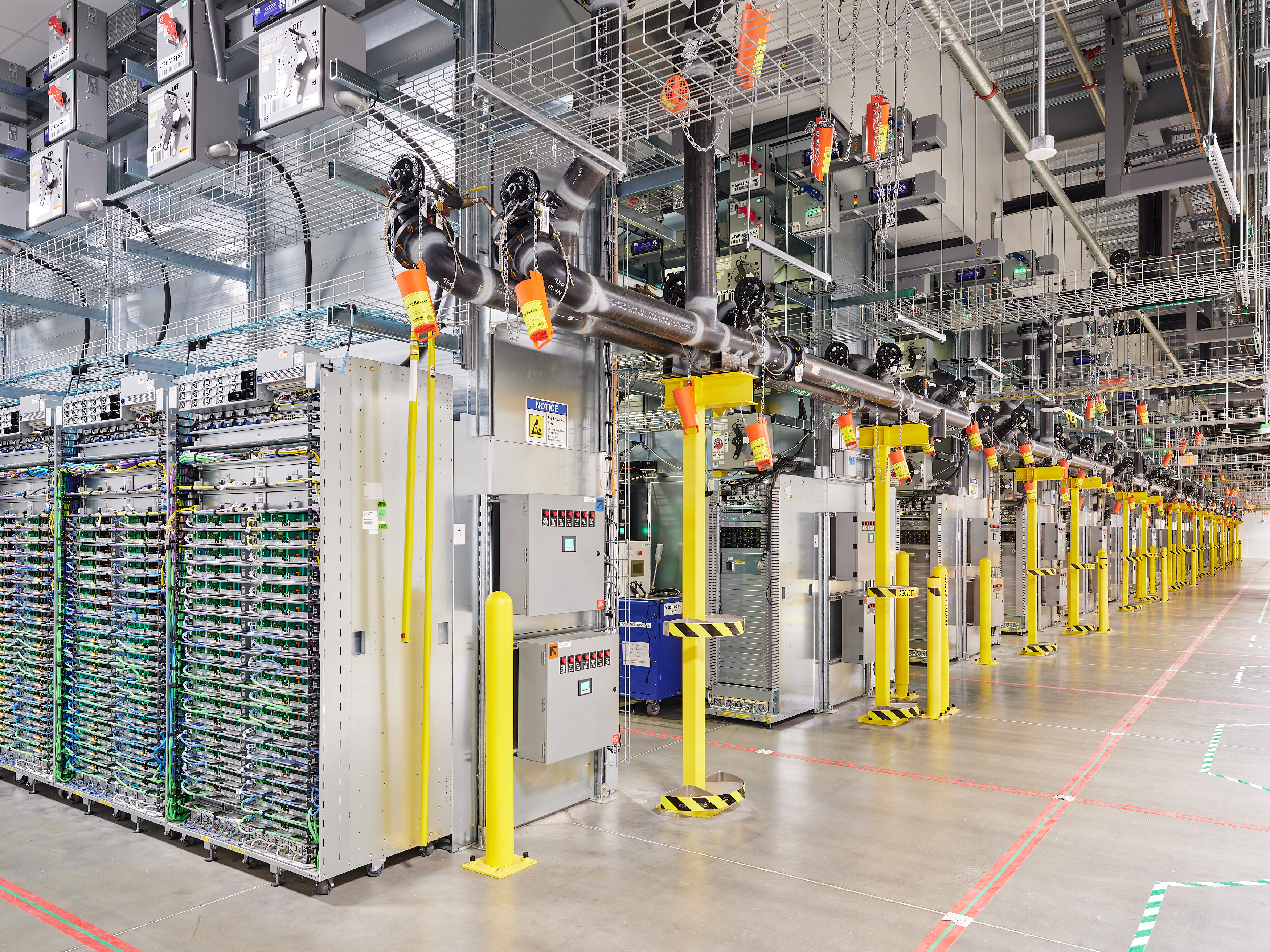
Google’s August 2025 demand-flexibility announcement put a commercial shape around an overlooked AI constraint: some computing can wait for a less strained electricity system. The company identified agreements with Indiana Michigan Power and Tennessee Valley Authority to reduce machine-learning workload demand when needed. These were specific arrangements with utilities, not a claim that all data-center activity can be switched off without consequences. Google data-center demand flexibility
Match the workload to the promise
Our analysis distinguishes urgent inference from work that can wait. A customer-facing agent may need an immediate response, while model evaluation or some training jobs may tolerate another schedule. A company that understands which workloads are flexible has more options than one treating every computation as equally time-sensitive.
Those options affect contracting. Capacity reserved for strict response commitments may have different economics from capacity used opportunistically. The right choice depends on the customer promise and consequences of delay. Lower unit prices are not savings if missed deadlines create support costs, customer churn or failed operational tasks.
Inspect demand, not just rates
Does the startup measure peak concurrency? Can non-urgent work move without disrupting service? Is the infrastructure bill driven by useful output or idle reservations? These details determine whether growth improves margins or increases fixed commitments. They also reveal whether apparent savings depend on unusually low demand during an early trial.
This is not a claim that all AI workloads can pause. It is an example of product design meeting infrastructure economics. Companies connecting service promises to realistic capacity planning may build more resilient businesses. The benefit must be established through contracts and measured performance rather than assumed from industry investment announcements. Flexible scheduling creates value only when it remains consistent with what the customer purchased.
A queue becomes an economic asset
Google said its approach could temporarily limit power used for some machine-learning work while preserving services people use directly. That separation is the central business idea. A batch of model evaluations has a different deadline from an agent answering a customer or a robot responding to a nearby worker. Treating those tasks as interchangeable makes electricity flexibility look easier than it is. Google data-center demand flexibility
An autonomy company has a potential advantage when it can separate the two classes cleanly. It can schedule training, simulations and retrospective analysis around capacity constraints while reserving immediate resources for live operation. The value comes from software architecture and customer promises as much as from the electricity tariff. A company that promises instant completion for every task has already given away much of its scheduling freedom.
Cloud contracts make the trade-off visible
AWS Savings Plans illustrate a related commercial mechanism. Its documentation describes discounts tied to a consistent hourly spending commitment over one or three years. This is a purchasing commitment, not a guarantee that every reserved dollar will produce useful work. A startup with volatile demand can achieve a lower advertised rate and still spend more than necessary if its commitment exceeds sustained usage. AWS Savings Plans documentation
Spot capacity exposes the other side of the bargain. AWS documents interruption notices and recommends interruption-tolerant designs; the usual two-minute warning has exceptions, including hibernation. The discount therefore comes with an engineering obligation. Checkpointing and retry logic are not optional details when the business depends on completing large simulations predictably. They determine how much of the cheap capacity is economically usable. AWS Spot interruption documentation
A grid problem is not just a chip problem
The International Energy Agency’s 2025 analysis projected global data-center electricity consumption of roughly 945 terawatt-hours in 2030 in its base case. That is a scenario, not a meter reading from the future. It gives scale to the issue while leaving the location and timing of individual constraints unresolved. A national total cannot tell an operator whether one substation can serve a particular project. IEA Energy and AI scenarios, 2025
For a young autonomy company, the practical exposure may arrive through a cloud provider rather than a direct utility bill. Delayed capacity can affect instance availability; expensive firm power can affect contract terms; geographic constraints can limit where data is processed. The company still needs to understand those dependencies even when it does not own the building, transformer or generator.
Flexibility can protect product margins
Consider two products using the same model. One must return an answer during a live customer conversation. The other reviews a fleet’s recorded operations overnight. The second has more room to shift work, group requests and recover from interruption. That difference can produce distinct margins even if the underlying model and nominal token prices are identical.
The comparison is analytical, not a claim about any named company’s profit. It explains why investors should not apply one infrastructure-cost assumption to every agent business. Response deadlines, geographic obligations and failure penalties are product characteristics. They become financial characteristics when the company signs a cloud contract or promises a service level to its own customer.
The evidence investors still need
Google’s utility agreements establish that flexible AI demand can be organized commercially. AWS documentation establishes that customers can exchange commitment or interruptibility for different pricing structures. Neither source proves that a particular startup has captured the resulting savings. That requires its own utilization, completion-time and cost data across representative operating conditions.
The strongest autonomy businesses will be able to explain which work is urgent, which work can move, and how that distinction survives growth. Energy flexibility is therefore a credible part of a business model, but not a substitute for one. Its value depends on delivering the customer’s promised result with fewer costly constraints, rather than merely making the infrastructure bill look cheaper on paper.
Sources & evidence
This archive preserves its original editorial date. Sources describe the events and announcements discussed; they do not establish today’s status.